
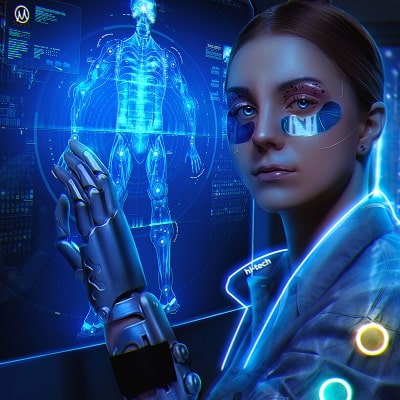
As technology and biology become increasingly intertwined, a new era beckons – that of the Cyborgs. These are individuals who have incorporated artificial components, enhancing or restoring their human capabilities. The line between man and machine is becoming increasingly blurred, and the following pioneers are leading the charge.
Who are considered cyborgs?
Cyborgs are humans whose bodies incorporate technology that interacts with biological systems, whether to restore a lost function, support an impaired one, enhance an existing ability, or create a form of perception that the body does not naturally possess. The term is broader than the science-fiction image of a person covered in machinery: it can include users of cochlear implants, advanced neuroprostheses, implanted stimulators, or other devices that exchange information with nerves, muscles, or sensory organs. In medical practice, such technologies are primarily developed to improve independence and quality of life after injury, illness, or disability. However, the boundary between treatment and enhancement is not always clear. A device may begin as a therapeutic aid and later provide capabilities beyond ordinary human limits. This raises practical questions about safety, long-term maintenance, privacy, access to software updates, and responsibility when an implanted system fails. For that reason, becoming a cyborg is not merely a matter of adding hardware to the body; it involves an ongoing relationship between the person, the device, and the digital systems that help it function.
Neil Harbisson
- Background: Born with achromatopsia, a rare condition that results in total color blindness, Harbisson chose not to be limited by his biological constraints.
- Cyborg Enhancement: He has an antenna implanted into his skull that translates colors into audible vibrations. This device, termed the “eyeborg,” allows Harbisson to hear colors, even those outside the human visual spectrum.
Nigel Ackland
- Background: After losing his arm in a work-related accident, Ackland decided to embrace advanced prosthetics.
- Cyborg Enhancement: Nigel sports one of the most advanced bionic arms, allowing him precision control, restoring much of the function of his lost limb.

Kevin Warwick
- Background: Often termed the “first human cyborg,” Warwick, a cybernetics professor, has been at the forefront of human augmentation.
- Cyborg Enhancement: Warwick has undergone multiple procedures, from simple RFID implants to more complex neural interfaces that allow him to interact with computers and even the nervous systems of other humans directly.
Amal Grafstra
- Background: A biohacker enthusiast, Grafstra has championed the integration of technology into the human body for convenience and enhanced capabilities.
- Cyborg Enhancement: With multiple RFID and NFC implants in his hands, Grafstra can unlock doors, log into computers, and more, with a simple wave.
Moon Ribas
- Background: A contemporary of Neil Harbisson, Ribas is a cyborg activist and avant-garde artist.
- Cyborg Enhancement: Ribas has an implanted sensor connected to online seismographs, allowing her to feel earthquakes in real-time. This seismic sense informs much of her performance art.
Why do people choose the technological path of development?
As technology continues its relentless march forward, the allure of merging biology with machinery offers promises of overcoming limitations, enhancing capabilities, and even introducing new sensory experiences. For many, it represents hope, for others, evolution. As our understanding deepens and technology becomes more advanced, it is likely that more individuals will venture down this cyborg path, blurring the boundaries of what it means to be human.