
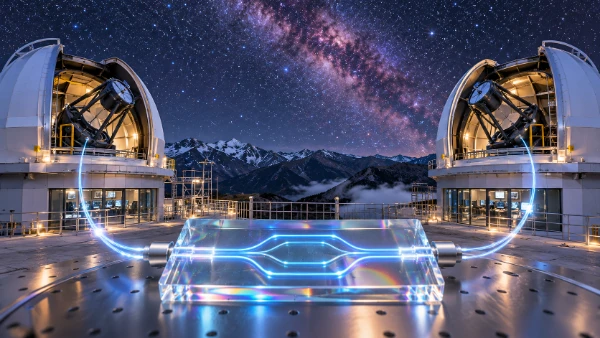
In October 2026, researchers at Heriot-Watt University in Scotland announced a significant advance in astronomical observation: a tiny glass photonic chip had successfully combined light from two separate telescopes, allowing them to work together as a single high-resolution instrument. Tested at the CHARA Array observatory in California, the device replaces part of the complicated optical equipment normally needed to combine telescope signals. The experiment is particularly important because it moves a technology developed over more than 15 years from laboratory research into real observations of stars. Published in Monthly Notices of the Royal Astronomical Society, the results demonstrate how compact light-guiding devices could make future astronomical instruments more precise, adaptable and easier to maintain.
How a Small Glass Chip Connects Two Astronomical Telescopes
The main challenge in high-resolution astronomy is not simply collecting more light but preserving enough information to distinguish extremely small details in distant objects. Conventional telescopes achieve sharper views by using larger mirrors, but constructing and operating enormous optical instruments is expensive and technically demanding. Another approach involves combining observations from telescopes positioned some distance apart. When their light is brought together correctly, astronomers can measure fine details that would otherwise require a much larger telescope. This technique, known as astronomical interferometry, has been used for decades, but the equipment required to combine optical signals remains complex.
The Heriot-Watt research team approached this problem by developing a photonic chip measuring only a few centimetres across. Rather than relying entirely on separate mirrors, lenses and other optical components, the device carries light through microscopic channels formed inside transparent glass. These channels guide and combine incoming signals while maintaining the relationships needed for precise astronomical measurements. The chip does not contain a camera, produce a complete image independently or replace the telescopes themselves. Its purpose is to perform a particularly delicate operation between collecting starlight and analysing the resulting information.
The device was developed by Professor Robert Thomson and Dr Aurélien Benoît at Heriot-Watt University’s Institute of Photonics and Quantum Sciences. Their work formed part of an international collaboration involving researchers in the United Kingdom, Germany and the United States. The glass component was installed within CHARIOT, an experimental instrument at the CHARA Array, where it successfully combined light collected by two telescopes. According to the university’s announcement on 27 October 2026, this represented an important milestone for a research programme that began more than 15 years earlier. The achievement was not simply making the chip work in controlled laboratory conditions, but demonstrating its usefulness during actual astronomical observations.
Why Combining Light Produces More Detailed Astronomical Measurements
Imagine looking at a distant star through two telescopes separated by a considerable distance. Each telescope receives light from the same object, but the incoming signals reach the instruments along slightly different paths. By comparing these signals with extraordinary care, astronomers can obtain information about the star’s apparent size, shape and structure. The larger the separation between the telescopes, the finer the angular details that can potentially be measured. This is why several smaller telescopes operating together can sometimes reveal features that a single telescope cannot distinguish. However, combining their signals does not automatically provide the same light-gathering ability as one enormous mirror.
The method depends on a phenomenon called interference, which occurs when light waves overlap and produce measurable variations in brightness. These variations contain information about the object being observed. To preserve that information, the light travelling from different telescopes must arrive at the combining instrument with carefully controlled timing and optical path differences. Even small disturbances can affect the measurements. Traditional interferometers therefore require sophisticated arrangements of optical equipment and continuous adjustments. The Heriot-Watt chip performs part of this work within a compact glass structure, reducing the number of separate optical elements needed for the beam-combining operation.
This distinction explains why the demonstration matters beyond the physical dimensions of the chip. Astronomers are not merely trying to make existing equipment smaller; they are looking for more dependable ways to measure subtle differences in light from distant objects. A compact optical component can make it easier to maintain stable relationships between light paths, although the wider observatory must still control atmospheric disturbances, telescope alignment and other sources of error. The 2026 experiment demonstrated that a glass chip can participate in these demanding measurements without sacrificing the essential precision required for stellar interferometry. It represents a practical improvement in how astronomical instruments can be constructed rather than a completely new way of collecting light from space.
Inside the CHARIOT Experiment at California’s CHARA Array
The successful observations took place at the CHARA Array on Mount Wilson in California. Operated by Georgia State University, the facility contains six telescopes, each with a primary mirror approximately one metre across. Their positions across the observatory allow researchers to combine observations from different telescope pairs and measure exceptionally fine angular details. CHARA has contributed to studies of stellar diameters, binary star systems and features on the surfaces of stars. Its established observing equipment and experience with interferometry made it an appropriate location to test whether the experimental photonic chip could handle the demands of real astronomical research.
The new instrument is called CHARIOT, short for CHara ARray Integrated Optics Testbench. It was designed to provide a flexible environment in which researchers could install, operate and evaluate different photonic components. Unlike the complete six-telescope array, the initial CHARIOT configuration was built to combine light from two telescopes. It uses optical fibres to deliver the collected light to the glass beam combiner. This design makes it possible to change important components without rebuilding the entire instrument. Researchers can therefore test different optical designs under actual observing conditions and compare their performance with established equipment.
During observing campaigns in 2024 and 2025, the international team successfully recorded interference signals from stars using CHARIOT. These observations provided evidence that the glass chip could operate beyond the laboratory and handle real starlight collected by separate telescopes. The study was led by Dr Aline N. Dinkelaker and published online on 21 September 2026, subsequently appearing in the October 2026 issue of Monthly Notices of the Royal Astronomical Society. The findings are particularly valuable because laboratory measurements alone cannot reproduce every challenge encountered at an observatory, including changing atmospheric conditions, variations in signal brightness and the operational demands of astronomical instruments.
What the 2024–2025 Observations Actually Demonstrated
One of the most significant outcomes was the instrument’s demonstrated measurement precision. For sufficiently bright stars, CHARIOT achieved better than 1% precision in measurements of raw squared fringe visibility, a quantity astronomers use to assess the interference signal produced by combining light from separate telescopes. In simpler terms, the instrument could measure small variations in the combined starlight with considerable consistency. This result applies to the particular type of measurement and observing conditions described in the research paper; it should not be interpreted as a claim that every astronomical measurement made with the chip has an error below 1%.
The researchers also assessed how faint a star the new instrument could observe. Their published results identify successful fringe detection for HD 210824, a star with a K-band magnitude of 5.212, under poor to moderate atmospheric seeing conditions. Astronomers use a magnitude scale to describe brightness, with larger numbers representing fainter objects. The K-band refers to near-infrared light, which lies beyond the wavelengths visible to human eyes. The observations showed that CHARIOT could detect interference signals from stars fainter than those previously reached by the system it replaced, although further improvements are needed to extend its sensitivity and precision for more demanding targets.
Another important finding was that CHARIOT already delivered performance comparable to JouFLU, the earlier instrument used for similar observations at CHARA. This comparison matters because a new component is useful only if it can provide reliable scientific measurements, not simply because it is smaller or easier to manufacture. The experiments established that the glass beam combiner could fulfil a genuine observational role while offering opportunities for future development. The published work did not announce the discovery of a new planet, a direct image of an exoplanet or a complete transformation of the observatory’s capabilities. Its achievement was the successful demonstration of a compact, high-precision method for combining telescope light under real conditions.

What Photonic Chips Could Change in Future Space Research
The broader significance of the Heriot-Watt experiment lies in the growing field of astrophotonics, which applies technologies for guiding and manipulating light to astronomical instruments. Photonic devices already have applications in telecommunications, sensing and scientific measurement. In astronomy, they offer ways to make optical instruments smaller while carrying out complicated functions with fewer individual components. This could be especially valuable as observatories become more sophisticated and researchers seek to obtain reliable measurements from increasingly faint and distant objects. Smaller instruments may also offer practical advantages where available space, maintenance access and mechanical stability are important considerations.
One potential application concerns the study of stars and planetary systems beyond our Solar System. Astronomers use high-resolution measurements to investigate properties such as stellar diameters, the behaviour of binary stars and the environments surrounding young stars. Such observations can improve models of how stars develop and how planets form around them. More advanced interferometric instruments could eventually help researchers investigate planetary systems in greater detail and contribute to techniques for detecting or characterising exoplanets. However, the 2026 CHARIOT experiment was a demonstration of beam-combining technology, not a direct observation of a planet using the new chip. Further improvements in sensitivity and instrumental performance would be required for more ambitious applications.
The technology may also influence how future observatories are upgraded. Complex optical instruments often require substantial engineering work when individual components need replacing or improving. CHARIOT was deliberately designed to make this process simpler: photonic chips can be exchanged within hours, allowing researchers to investigate new designs without lengthy reconstruction. This flexibility is particularly useful for scientific development, where successive experiments reveal which components perform best. Although compact optical devices do not eliminate the need for supporting equipment, they can reduce the complexity of individual functions and make it more practical to introduce improvements as new methods become available.
Why Laser-Written Glass Technology Matters Beyond This Experiment
The glass chip itself was manufactured using a process called ultrafast laser inscription. During fabrication, extremely short laser pulses create permanent changes within a piece of transparent material, forming narrow paths that can guide light. These internal paths are known as optical waveguides. In the Heriot-Watt device, they were written into a specialised form of quartz glass known as Infrasil, selected for its favourable transmission properties in the near-infrared K-band. The process allows researchers to produce carefully arranged optical pathways inside a solid component rather than assembling every connection from separate miniature parts.
This method offers an important engineering advantage because the layout of the internal channels can be designed for a particular task. Light can be directed, divided and recombined through pathways created within the same glass component. Different chip designs can therefore provide different optical functions while retaining a compact physical form. In CHARIOT, the chip is connected to the wider instrument through optical fibres, making replacement comparatively straightforward. Nevertheless, these advantages must be assessed alongside practical limitations, including the amount of light lost during transmission, the stability of connections and the ability to work with increasingly faint astronomical sources.
As of November 2026, the Heriot-Watt chip has demonstrated a successful and scientifically useful way to combine light from two telescopes, but it remains part of an experimental instrument rather than a universal replacement for conventional astronomical optics. Its most immediate contribution is providing researchers with a working design they can improve and test at a major observatory. The collaboration between Heriot-Watt University, German research institutions and the CHARA team illustrates how laboratory photonics research can translate into practical astronomical equipment. By bringing a delicate optical function into a glass component only a few centimetres across, the project creates opportunities to develop more compact instruments capable of supporting increasingly precise observations of stars and planetary systems.