
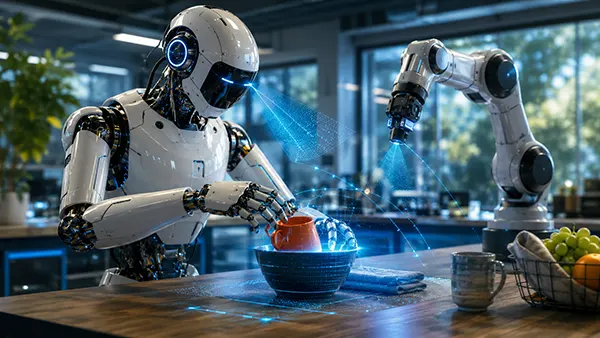
Physical artificial intelligence describes AI systems that do more than interpret text, images or data. They receive information from cameras, microphones, force sensors, joint encoders and other devices, then use that information to control a machine in the physical world. The machine may be a robotic arm, a warehouse vehicle, a humanoid robot, a drone or an autonomous laboratory device. The central challenge is that real environments are never perfectly predictable. Objects move, lighting changes, surfaces behave differently and people may interrupt a task without warning. By 2026, research has moved from narrowly programmed motions towards models that can connect visual understanding, spoken or written instructions, spatial reasoning and motor control. The progress is significant, but it should be viewed carefully: current systems can handle broader task ranges than earlier robots, yet dependable operation across every unfamiliar setting remains an unsolved problem.
From Digital Intelligence to Machines That Perceive and Move
A conventional AI model can label an object in a photograph or explain how to pick it up. A physical AI model must also locate that object, estimate its shape and position, choose a safe approach, close a gripper with suitable force and confirm that the grasp succeeded. This difference is often described as embodiment: intelligence is connected to a body with particular dimensions, joints, sensors and limits. A small tabletop arm cannot use the same movement as a humanoid, and a wheeled robot cannot step over an obstacle. Effective models therefore need knowledge of both the task and the machine carrying it out. They must also respect practical constraints such as reach, balance, battery level, payload, speed and the presence of people nearby.
Many current systems use vision-language-action models, usually shortened to VLA models. They combine camera views with a natural-language instruction and produce a sequence of actions. The instruction might be “place the red cup in the upper drawer”, while the visual input shows the room, furniture and available objects. The model links words to visible items, divides the request into smaller steps and generates movements for the robot. Some designs separate higher-level reasoning from lower-level control. A reasoning component decides what should happen next, while a control model translates that plan into joint movements. This division is useful because planning a task and maintaining stable motion require different kinds of processing, even when they work together in one system.
Examples released by 2026 show how quickly this approach is developing. Google DeepMind presented Gemini Robotics 2 as a VLA model for robot bodies ranging from tabletop devices to humanoids, with whole-body control, dexterous manipulation and the ability to respond to updated instructions. Its On-Device 2 model is designed to run locally when network access is limited. Physical Intelligence described π0.7 as a generalist robot model trained with demonstrations, imperfect autonomous attempts and data from several robot types. NVIDIA’s Cosmos 3 research focuses on models that interpret and simulate physical scenes, while its GR00T work targets general robot learning. These releases are important research markers, but demonstrations and early-access models are not the same as proven, unattended operation in homes or factories.
The Perception, Reasoning and Action Loop
Physical AI works through a repeating loop rather than a single prediction. First, sensors capture the current state of the environment. Cameras provide colour, depth and motion; joint encoders report the position of the robot’s limbs; force and torque sensors reveal contact; tactile sensors can indicate whether an object is slipping. The model uses these signals to identify objects, estimate distances and understand relationships such as “inside”, “behind”, “within reach” or “blocked”. A useful system must also separate relevant information from background detail. In a crowded workbench scene, for example, it should focus on the requested component while still noticing a person’s hand entering the workspace.
Next comes reasoning and planning. The robot converts a broad instruction into an ordered sequence that can be executed. “Clear the table” may require recognising which items belong elsewhere, deciding where each one should go, selecting a safe order and moving around obstacles. Long tasks are difficult because every step changes the next one. A cup may be moved successfully, but a plate can shift, a drawer may fail to open or a target area may already be occupied. Modern models increasingly use visual and language knowledge to revise plans instead of following a fixed script. They can also check whether a subtask is complete before continuing, which reduces the chance that one unnoticed error will spoil the entire sequence.
Finally, the system acts and observes the result. This feedback stage is essential because a planned movement rarely produces exactly the expected outcome. Wheels slip, joints flex and soft objects deform. A closed-loop controller compares the intended state with the latest sensor readings and adjusts speed, direction or grip. If a grasp fails, the robot may reposition the camera, choose another contact point or ask for help. This constant correction is one reason physical AI differs from generating a sentence: the answer is tested immediately by the world. Each movement creates new evidence, and the model must use it quickly enough to keep the task stable and safe.
How Physical AI Models Learn Practical Skills
The most direct training method is demonstration. A person may guide a robot arm by hand, control it with joysticks, use motion-capture equipment or operate it remotely while cameras and sensors record every step. The resulting dataset links observations, instructions and actions. Imitation learning then teaches the model to reproduce patterns found in successful examples. Large shared datasets help reduce dependence on one machine or one laboratory. The Open X-Embodiment project, for instance, combined data from 22 robots across 21 institutions and included 527 skills covering more than 160,000 tasks. Such collections allow a model to learn common ideas—grasping, placing, opening or wiping—from varied hardware and environments rather than memorising one setup.
Language, images and video can add broader knowledge that robot demonstrations alone do not contain. Internet-scale visual data can help a model recognise thousands of objects and understand everyday instructions, while robot recordings show how those concepts connect to movement. Physical Intelligence’s π0.5 research combined data from different robots with language, object information, high-level task descriptions and web data. In experiments, the model completed multi-stage cleaning tasks in homes not used for training. This does not mean that watching ordinary video directly teaches a machine safe motor control. Visual knowledge is most useful when paired with action data that records what the robot did, how the environment responded and whether the task succeeded.
Training data also includes failure. Earlier systems often learned mainly from carefully selected successful demonstrations, but that leaves them poorly prepared for mistakes. Newer methods can use unsuccessful grasps, interrupted motions and partially completed tasks to teach recovery. A failed attempt shows which states should be avoided and how an action can go wrong. Reinforcement learning adds another route: the robot receives a reward for progress and a penalty for unsafe or ineffective behaviour, then improves through repeated trials. Most large-scale trial-and-error work takes place in simulation because damaging a virtual object is cheaper and safer than damaging a real robot. Limited real-world practice is then used to correct the remaining mismatch.
Why Simulation Cannot Replace Real Experience
Simulation gives developers control over lighting, object position, room layout and robot settings. Thousands of virtual robots can practise at the same time, producing far more experience than one physical machine could collect. Developers can vary textures, friction, camera angles and object weights so that the model does not depend on one perfect scene. World models extend this idea by predicting how a scene might change after an action. A model can compare several possible movements before the robot performs one. In 2026, research systems such as NVIDIA Cosmos and scene-building methods such as SimFoundry are aimed at producing richer simulated environments and synthetic training data for robotics and autonomous machines.
Yet virtual training always simplifies reality. Contact between hard and soft materials is difficult to reproduce precisely. Transparent objects confuse cameras, cables catch on edges, packaging bends and liquids move in ways that are costly to model. Sensors also contain noise and delay that a clean simulation may underestimate. This difference is known as the simulation-to-real gap. A policy that appears reliable in a virtual test can become unstable when a wheel loses traction, a gripper pad wears down or sunlight changes the camera image. For this reason, teams use simulation as a large practice area, then validate behaviour on real hardware under gradually broader conditions.
Real-world experience is especially important for recovery and judgement. A capable robot must know not only how to complete a task, but also when to slow down, stop or request assistance. It needs examples of crowded spaces, unusual object positions, damaged tools and incomplete instructions. Human supervisors remain valuable because they can label subtle failures that an automatic score may miss, such as placing a fragile item too close to an edge. High-quality data is therefore more than a large number of recordings. It needs accurate sensor synchronisation, clear task descriptions, varied conditions and honest records of both success and failure. Without that foundation, a large model can learn unreliable shortcuts.
What Physical AI Can Do in 2026 and Where It Still Falls Short
Industrial and logistics settings are among the strongest near-term uses because tasks can be defined and work areas can be controlled. Physical AI can help robots recognise mixed parts, adapt a grasp to small changes, inspect products, sort parcels and respond to natural-language instructions. This is more flexible than traditional automation that expects every item to arrive in the same pose. However, dependable industrial use still requires careful engineering around the model. Fixtures, calibrated cameras, tested grippers, access controls and emergency systems remain essential. A foundation model may improve task selection and adaptation, but it does not remove the need for process design, maintenance and measurable quality checks.
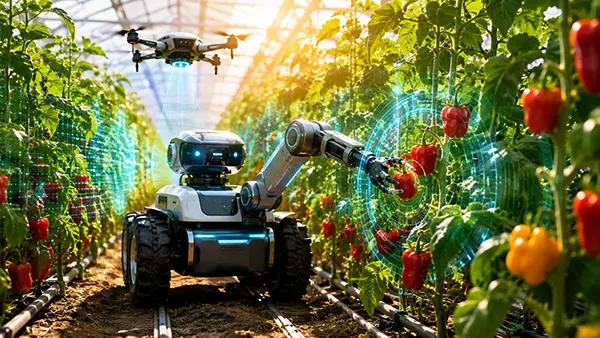
Research demonstrations also cover household work, agriculture, laboratories and healthcare. Mobile manipulators have cleaned rooms, moved objects between locations and followed multi-step instructions in unfamiliar homes. Agricultural machines can use vision to identify crops or weeds, while laboratory robots can automate repeated handling and measurement. Medical robotics is progressing through larger shared datasets and models for tasks such as surgical manipulation, ultrasound and endoscopy, but these areas demand strict supervision, clinical evidence and regulatory approval. In 2026, it is more accurate to describe many of these systems as advanced research or limited-purpose tools than as autonomous replacements for trained professionals.
Autonomous vehicles, drones and field robots are also forms of physical AI because they must perceive changing surroundings and act under time pressure. Their models combine maps, cameras, radar, lidar or other sensors with motion planning and control. The operating problem differs from tabletop manipulation, yet the learning challenge is similar: rare events matter greatly, and a confident error can have physical consequences. Weather, damaged roads, unusual human behaviour and sensor obstruction create cases that may not appear often in training data. Reliable deployment therefore depends on restricted operating conditions, repeated validation and fallback behaviour, not only on better recognition or language understanding.
Safety, Reliability and the Next Stage of Progress
A robot that can reason broadly still needs independent safety layers. These may include speed and force limits, collision detection, protected work zones, emergency stops, dedicated safety sensors and a controller that can reject an unsafe action. Semantic checks are also becoming important. A robot should recognise that a technically possible instruction may be inappropriate, such as moving a sharp tool towards a person or placing a hot object on an unstable surface. Current research increasingly favours modular safeguards rather than trusting one end-to-end model with every decision. In industrial settings, the updated ISO 10218-1:2025 and ISO 10218-2:2025 standards address robot design and the safe integration of robot applications, reinforcing the need for risk reduction beyond the AI model itself.
Reliability must be measured in conditions that resemble actual use. A high success rate on a familiar benchmark says little about performance in a cluttered room, after sensor drift or during a long sequence of tasks. Useful evaluation includes task completion, collision frequency, human intervention, recovery after failure, response time and performance with unfamiliar objects. Developers should also report operating limits and known weaknesses through model cards or equivalent documentation. By August 2026, the strongest evidence still comes from repeated real-robot trials across different environments. A polished video can show capability, but it cannot establish how often the same behaviour fails or how safely the system handles an unexpected event.
The next phase is likely to combine larger shared datasets, stronger world models, smaller on-device models and better transfer between robot bodies. Robots may learn a broad base of skills centrally, then adapt locally with a modest number of examples from a new machine. Multiple robots may also share experience, allowing one system’s verified recovery to improve others. Even so, progress will depend less on impressive one-off tasks and more on consistency, transparent evaluation and controlled learning after deployment. Physical AI in 2026 is moving from fixed automation towards machines that can interpret instructions and adjust their behaviour, but general-purpose robots that work safely in any ordinary environment are not yet a solved technology.