
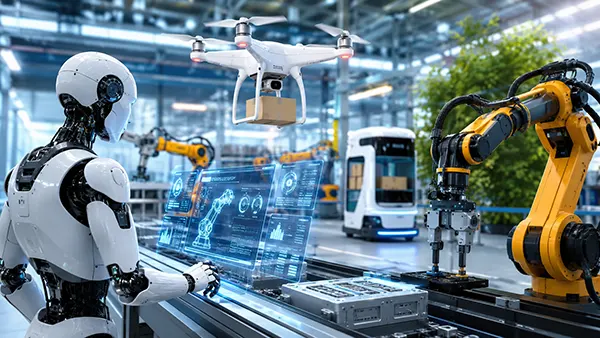
Artificial intelligence has already transformed how people search for information, create content and automate routine office tasks. However, the most significant shift taking place in 2026 is happening outside computer screens. AI is increasingly becoming a physical technology capable of perceiving the real world, making autonomous decisions and interacting directly with its surroundings. This transition has given rise to what researchers and technology companies commonly describe as Physical Artificial Intelligence. Instead of limiting AI to text generation or image recognition, developers are embedding intelligent systems into industrial robots, autonomous vehicles, logistics equipment, drones, healthcare devices and advanced manufacturing lines. As computing power, sensor technology and machine learning continue to improve, AI is no longer analysing reality from a distance—it is becoming an active participant within it.
What Physical Artificial Intelligence Means in 2026
Physical Artificial Intelligence refers to AI systems that combine perception, reasoning and physical action within real-world environments. Unlike traditional software assistants, these systems continuously receive information from cameras, LiDAR scanners, radar, microphones, pressure sensors, force sensors and positioning technologies. They process this information in real time before deciding how to move, manipulate objects or cooperate safely with people.
The concept has gained momentum because several technological barriers have been overcome simultaneously. More efficient AI accelerators allow complex neural networks to operate directly inside machines instead of relying entirely on remote cloud infrastructure. Advances in computer vision enable robots to recognise objects with remarkable precision, while modern reinforcement learning techniques help machines improve through repeated interaction with their environments rather than following rigid, pre-programmed instructions.
Physical AI should not be confused with traditional industrial automation. Conventional automation executes predefined sequences under controlled conditions. Physical AI systems are designed to cope with uncertainty. They identify unexpected obstacles, adapt to changing situations, estimate risk and modify their behaviour without requiring engineers to rewrite control software whenever conditions change.
Why Physical AI Has Become a Major Technology Trend
Several global developments have accelerated investment in intelligent machines. Labour shortages across manufacturing, logistics and agriculture continue to affect many developed economies. Businesses increasingly require automation that can perform complex tasks without eliminating flexibility. Physical AI provides a practical response by allowing machines to operate in environments that were previously considered too unpredictable for automation.
Rapid progress in foundation AI models has also influenced robotics. Large-scale models originally developed for language understanding are now being adapted to help robots interpret spoken instructions, understand spatial relationships and plan sequences of actions. Instead of programming every individual movement, engineers can increasingly provide high-level objectives while AI determines the detailed execution strategy.
Investment from leading technology companies has reinforced this direction. NVIDIA has expanded its Isaac robotics ecosystem alongside digital simulation environments for training autonomous machines. Tesla continues developing Optimus, its humanoid robot, while companies including Boston Dynamics, Figure AI, Agility Robotics, Sanctuary AI and Unitree Robotics are advancing increasingly capable robotic systems for industrial and commercial use. Their progress demonstrates that physical intelligence has moved from research laboratories towards large-scale commercial deployment.
How Intelligent Robots Are Transforming Manufacturing
Manufacturing has become one of the fastest-growing areas for Physical Artificial Intelligence because factories combine repetitive production with constantly changing operational requirements. Modern production facilities increasingly require robots capable of handling multiple product variations without lengthy reprogramming. AI enables machines to recognise different components, adjust their grip automatically and modify assembly procedures according to real-time production data.
Vision-guided robotics has become particularly important. Instead of relying on precisely positioned parts, AI-powered cameras allow robotic arms to locate randomly placed components, determine their orientation and perform accurate assembly. This capability reduces the need for expensive mechanical positioning equipment while increasing production flexibility.
Predictive maintenance has become another major application. AI continuously analyses vibration, temperature, acoustic signals, electrical consumption and equipment behaviour to identify signs of mechanical wear before failures occur. Maintenance teams receive early warnings that help reduce downtime, improve equipment lifespan and minimise unexpected production interruptions.
AI-Powered Factories and Digital Twins
One of the most important developments in modern manufacturing is the widespread adoption of digital twins. A digital twin is a continuously updated virtual representation of a physical machine, production line or entire factory. Data collected from sensors installed throughout the facility is synchronised with its digital counterpart, allowing engineers to monitor performance, evaluate efficiency and simulate operational changes without interrupting production. By 2026, digital twins have become an integral part of many advanced manufacturing strategies, particularly in the automotive, aerospace, electronics and pharmaceutical industries.
Physical AI significantly increases the value of digital twins because intelligent systems can interpret operational data rather than simply displaying it. AI identifies production bottlenecks, predicts the effects of equipment adjustments, recommends process improvements and estimates the impact of introducing new products before physical implementation begins. Manufacturers can test different production scenarios in simulation, reducing financial risk and shortening deployment times.
Collaborative robots, commonly known as cobots, have also evolved considerably. Unlike conventional industrial robots that operate inside safety cages, cobots are designed to work alongside people. Physical AI enables these machines to detect human movement, recognise gestures, estimate safe operating distances and adjust their speed accordingly. This creates production environments where humans continue performing tasks requiring judgement and dexterity while robots handle repetitive lifting, positioning, inspection and transportation activities.
From Autonomous Drones to Intelligent Mobile Machines
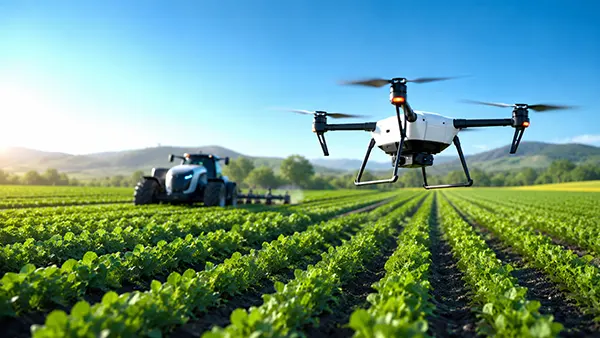
Drones represent one of the clearest examples of Physical Artificial Intelligence operating beyond traditional industrial settings. Early commercial drones largely depended on predefined flight paths and remote human operators. Modern AI-powered drones combine computer vision, satellite navigation, inertial measurement systems and onboard machine learning to navigate independently through highly dynamic environments.
Infrastructure inspection has become one of the fastest-growing commercial applications. Energy companies, railway operators, telecommunications providers and utility networks increasingly deploy autonomous drones to inspect power lines, wind turbines, bridges, pipelines and solar farms. AI automatically identifies corrosion, structural deformation, vegetation encroachment and equipment damage, allowing maintenance teams to focus on verified issues rather than manually reviewing thousands of photographs.
Agriculture has also become an important field for Physical AI. Smart drones equipped with multispectral cameras monitor crop development, detect disease outbreaks, estimate water stress and identify nutrient deficiencies across large agricultural areas. Combined with AI-based analysis, farmers receive precise recommendations for irrigation, fertiliser application and pest management, improving yields while reducing unnecessary chemical use.
Autonomous Navigation Beyond GPS
One of the biggest engineering challenges for autonomous machines is reliable navigation in environments where satellite signals are weak or unavailable. Warehouses, underground mines, dense urban areas and industrial facilities often interfere with conventional GPS positioning. Physical AI addresses this challenge by combining information from multiple sensor types rather than relying on a single navigation source.
Simultaneous Localisation and Mapping (SLAM) has become a core technology for many autonomous robots. Using cameras, LiDAR, radar and inertial sensors, AI continuously builds a three-dimensional map while determining the machine’s own position within that environment. As new obstacles appear, the system updates its map instantly and calculates alternative routes without requiring external guidance.
Advances in edge computing have further improved autonomous operation. Instead of transmitting every sensor reading to distant data centres, powerful AI processors installed directly inside robots and drones perform complex inference locally. This reduces latency to milliseconds, improves operational reliability in areas with poor connectivity and strengthens data privacy because sensitive information can remain inside the device itself.