
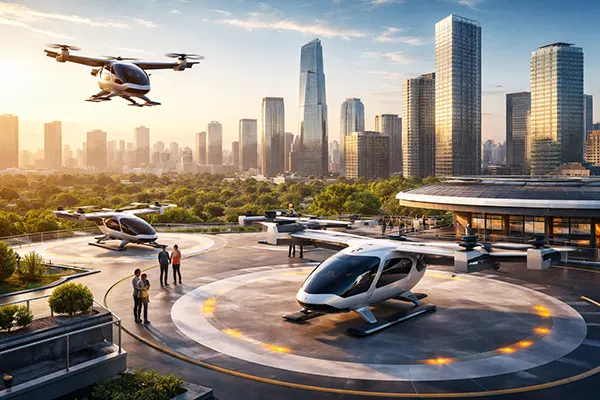
Urban air taxis have moved from concept visuals to real prototypes tested by companies such as Joby Aviation, Volocopter and Lilium. By 2026, several pilot programmes have already taken place in cities like Paris, Dubai and Los Angeles. Yet despite visible technological progress, large-scale deployment remains limited. The barriers are not purely technical; they involve regulation, infrastructure, public acceptance and economic viability, all of which must align before routine operations can begin.
Regulatory frameworks and certification challenges
The primary obstacle remains certification of electric vertical take-off and landing (eVTOL) aircraft. Aviation authorities such as the European Union Aviation Safety Agency (EASA) and the Federal Aviation Administration (FAA) are still finalising standards specific to this new category. Unlike conventional aircraft, eVTOL systems combine elements of helicopters, drones and fixed-wing aviation, requiring entirely new safety frameworks.
Certification timelines are lengthy because these aircraft must meet strict requirements for redundancy, battery reliability and autonomous systems. Any failure scenario must be analysed in detail, which slows approval processes. Even companies that have completed thousands of test flights still face several years of validation before commercial clearance is granted.
Additionally, airspace integration poses a regulatory challenge. Urban skies are already used by helicopters, emergency services and drones. Authorities must define traffic management systems capable of handling high volumes of low-altitude flights without increasing collision risk.
Air traffic management in dense urban environments
Traditional air traffic control systems are not designed for dozens or hundreds of short-range flights within a single city. Urban air mobility requires automated traffic management solutions capable of real-time coordination between multiple vehicles.
By 2026, several experimental systems are being tested, including Unmanned Traffic Management (UTM) platforms. These rely on digital communication, geofencing and AI-assisted routing. However, scaling these systems to handle commercial volumes remains an unresolved issue.
Coordination between aviation authorities, local governments and private operators is also complex. Each city may adopt slightly different rules, making standardisation across regions difficult and slowing international deployment.
Infrastructure limitations and urban integration
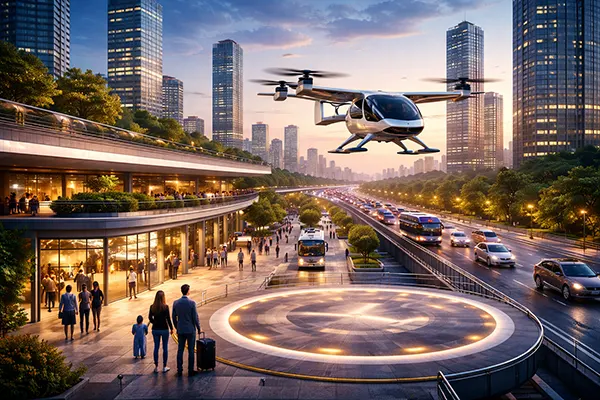
Even if aircraft receive certification, cities are not yet physically prepared for widespread air taxi operations. Dedicated take-off and landing zones, known as vertiports, must be constructed in strategic locations such as business districts, airports and transport hubs.
Building vertiports requires significant investment and urban planning approval. These structures must meet safety regulations, noise standards and accessibility requirements. In densely populated cities, finding suitable space is a major constraint.
Energy infrastructure is another critical factor. eVTOL aircraft depend on high-capacity charging systems. Fast-charging stations must be installed at vertiports, and local power grids must be upgraded to handle increased demand.
Noise, safety perception and community resistance
Although eVTOL aircraft are quieter than helicopters, they still generate noticeable noise, particularly during take-off and landing. Residents in urban areas often raise concerns about constant aerial activity above жилые районы.
Public perception plays a decisive role. Surveys conducted between 2023 and 2025 indicate that many people remain cautious about flying in small electric aircraft, especially those with autonomous features. Concerns about safety, privacy and visual pollution contribute to resistance.
City authorities must therefore balance innovation with social acceptance. Without clear communication and gradual introduction, public opposition can delay or block infrastructure projects.
Economic viability and operational costs
Another major factor slowing deployment is cost. Developing eVTOL aircraft requires billions in investment, and companies must recover these expenses through commercial operations. Initial ticket prices are expected to be significantly higher than traditional ground transport.
Operational costs include maintenance, battery replacement, pilot training and insurance. Although automation may reduce labour costs in the future, current regulations still require trained pilots, which limits scalability.
Market demand is also uncertain. While there is interest from business travellers and premium users, mass adoption depends on affordability. Without sufficient passenger volume, operators may struggle to achieve profitability.
Business models and long-term sustainability
Several business models are being tested, including airport transfers, corporate mobility services and tourism routes. Short, high-demand connections are considered the most viable starting point for operations.
Partnerships between manufacturers, airlines and urban mobility providers are becoming more common. These collaborations aim to integrate air taxis into existing transport ecosystems rather than positioning them as standalone solutions.
Long-term sustainability depends on reducing costs, improving battery efficiency and achieving regulatory approval for autonomous operations. Only when these factors align can urban air taxis transition from limited pilot projects to everyday transport options.