
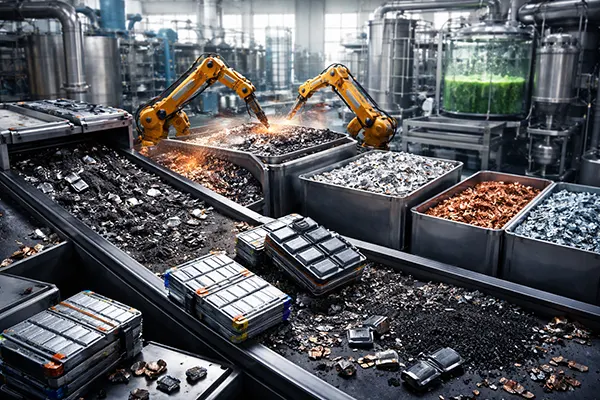
LFP (LiFePO4) cells are now common in EVs and stationary storage, which means large volumes will reach end-of-life this decade. Technically, they are recyclable, but the “value story” is different from nickel-cobalt chemistries: you are mainly chasing lithium, aluminium/copper foils, graphite, and phosphate/iron compounds rather than high-value cobalt. In 2026, industrial practice is converging on three route families—pyrometallurgy, hydrometallurgy and direct regeneration—with mechanical pre-treatment sitting upfront in almost every flowsheet.
Front-end processing: safe discharge, dismantling and black mass preparation
Most LFP recycling lines begin with risk reduction: state-of-charge management, electrical isolation, and controlled opening of packs/modules. In practice, recyclers aim to avoid thermal events and HF-forming conditions by keeping the process dry where possible, controlling temperature, and removing obvious hazards early (electronics, plastics, electrolyte reservoirs). This stage is often where the largest variability appears, because pack formats, adhesives, and cell designs are not uniform across manufacturers.
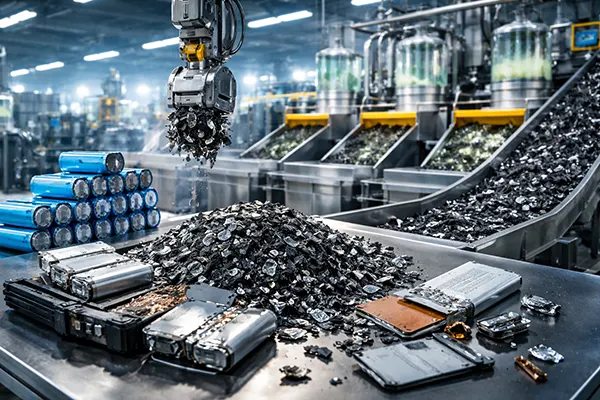
After dismantling (or sometimes without it, depending on the business model), cells are shredded under inert conditions and then separated mechanically. The goal is to split “coarse” fractions (steel casings, aluminium and copper foils, plastics) from the fine fraction commonly called black mass. For LFP, black mass typically contains cathode (LiFePO4), anode graphite, carbon additives, binder residues, and fine pieces of current collectors.
Real output quality depends on how well the line manages cross-contamination. Copper in black mass can disrupt downstream lithium purification; aluminium can consume leaching reagents or create gels in aqueous steps. Many plants therefore add staged sieving, magnetic separation, density separation, and sometimes a mild thermal step to remove organics and improve liberation before chemical processing.
What “good” black mass looks like for LFP and why it matters
For LFP, a commercially useful black mass is less about cobalt/nickel grade and more about predictability: controlled copper/aluminium carry-over, manageable fluorine levels from binder/electrolyte residues, and a consistent graphite-to-cathode ratio. If the feed is a mixed stream (LFP blended with NMC/NCA), the black mass chemistry can swing dramatically, and that changes which route is economically sensible.
In 2026, many operators treat LFP-rich and mixed black mass differently. LFP-rich material can target lithium recovery plus iron/phosphate products, while mixed streams may prioritise Ni/Co recovery first and treat the remaining phosphate-rich residue separately. Sorting by chemistry upstream (labelling, pack-level ID, or data-driven sorting) is therefore becoming a practical lever for both yield and cost.
Quality control at this stage is not a paperwork exercise. Simple routine checks—loss on ignition (organics), particle size distribution, Cu/Al assays, fluorine screening—can prevent expensive surprises later. When these checks are skipped, plants often pay twice: first in higher reagent consumption, and then again in harder wastewater treatment and lower purity products.
Hydrometallurgical routes: selective leaching to lithium salts and phosphate/iron products
Hydrometallurgy is widely used because it can recover lithium at relatively high rates even when the cathode does not contain valuable transition metals. A typical approach combines mechanical pre-treatment with leaching (acidic, alkaline, or water-based variants), followed by impurity removal and lithium purification. For LFP, the process design has to deal with phosphate chemistry: iron and phosphate tend to co-precipitate unless conditions are carefully controlled.
Industrial flowsheets often start with targeted removal of aluminium (for example, alkaline leaching) and then move to lithium recovery. Depending on the chosen chemistry, lithium can be recovered as lithium carbonate (common in supply chains) or as lithium phosphate intermediates. Iron may end up as iron phosphate (FePO4) or iron oxides/hydroxides after adjustment of redox state and pH.
In 2026, the most important practical constraint is not whether lithium can be leached—it can—but whether the downstream purification is robust enough for variable feed. Copper, aluminium, manganese/nickel traces (from mixed chemistries), and fluorinated residues can complicate precipitation and crystallisation. That is why “selectivity” is a bigger buzzword than “high leaching rate” in serious process design discussions.
Realistic yields, targets and where the losses usually happen
Losses typically concentrate in three places: (1) incomplete liberation at the mechanical front-end (active material still stuck to foils), (2) lithium trapped in residues when leaching conditions are chosen to protect iron/phosphate streams, and (3) purification steps where lithium is sacrificed to remove impurities. Those losses are not always failures—sometimes they are a deliberate trade-off to hit product specifications.
From a regulatory standpoint in the EU, facilities are moving towards specific recovery targets. The EU Batteries Regulation sets minimum recycling efficiency targets for lithium-based batteries (65% by average weight by the end of 2025, rising to 70% by the end of 2030) and minimum material recovery targets including lithium (50% by 31 December 2027 and 80% by 31 December 2031). These targets influence how plants balance throughput, selectivity, and product purity.
In commercial operations, “yield” should be discussed as a mass balance across products, not only lithium. A well-run LFP hydromet line can produce saleable lithium salts plus an iron/phosphate product stream, but only if impurities and wastewater are managed. If wastewater treatment is undersized, the plant may technically recover lithium yet struggle to run continuously within discharge limits, which is effectively a yield problem over time.
Direct regeneration and hybrid routes: keeping the cathode structure in the loop
Direct regeneration aims to preserve (or restore) the cathode material rather than breaking it fully into salts. For LFP this can mean re-lithiation, defect healing, particle surface treatment, and carbon re-coating so the regenerated powder performs like a usable cathode again. The appeal is straightforward: fewer chemical steps, potentially lower energy use, and a product that can return to battery manufacturing without going through commodity refining stages.
In 2026, direct regeneration is most plausible when the feed is relatively clean and chemistry-sorted. If an LFP stream is heavily mixed with other cathodes, or if the material is degraded beyond repair (severe particle cracking, contamination with copper/aluminium fines), the direct route becomes more difficult. That is why many real-world projects use hybrid schemes: mechanical separation and cleaning first, then either direct regeneration for the “good” fraction and hydromet for the rest, or direct regeneration supported by mild leaching to remove impurities.
Performance validation is the make-or-break point. Regenerated LFP needs consistent particle size, low impurity levels, and stable electrochemical behaviour across batches. That requires process control, not just a clever lab method. Plants that treat regeneration as a powder-processing and QA discipline (not purely a recycling discipline) tend to be the ones that move beyond pilot scale.
Choosing a route in 2026: a practical decision checklist
Route selection increasingly starts with two questions: “What is the feed?” and “What is the sales channel for outputs?” If you have stable, LFP-rich black mass and an offtake for lithium carbonate and iron phosphate products, hydrometallurgy can be a dependable option. If you have chemistry-sorted LFP and a customer willing to qualify regenerated cathode powder, direct regeneration can capture more value per tonne of cathode material processed.
Regulation and traceability also play a bigger role year by year. EU requirements around recycling efficiency, material recovery, and battery information flows are pushing operators to document yields and destinations of fractions, not just run the process. That can favour routes with clearer accounting of where lithium ends up and how product quality is assured, especially when buyers require audited data.
Finally, do not underestimate the “unsexy” constraints: energy price, reagent price volatility, permitting for emissions/wastewater, and the ability to run safely at scale. LFP recycling economics are often marginal compared to cobalt-rich chemistries, so operational reliability and clean mass balance accounting can matter as much as headline recovery figures when a plant is judged over a full year.